Why Most Construction Cashflow Forecasts Fail — And How to Fix Them
A systems-based approach to construction cashflow forecasting
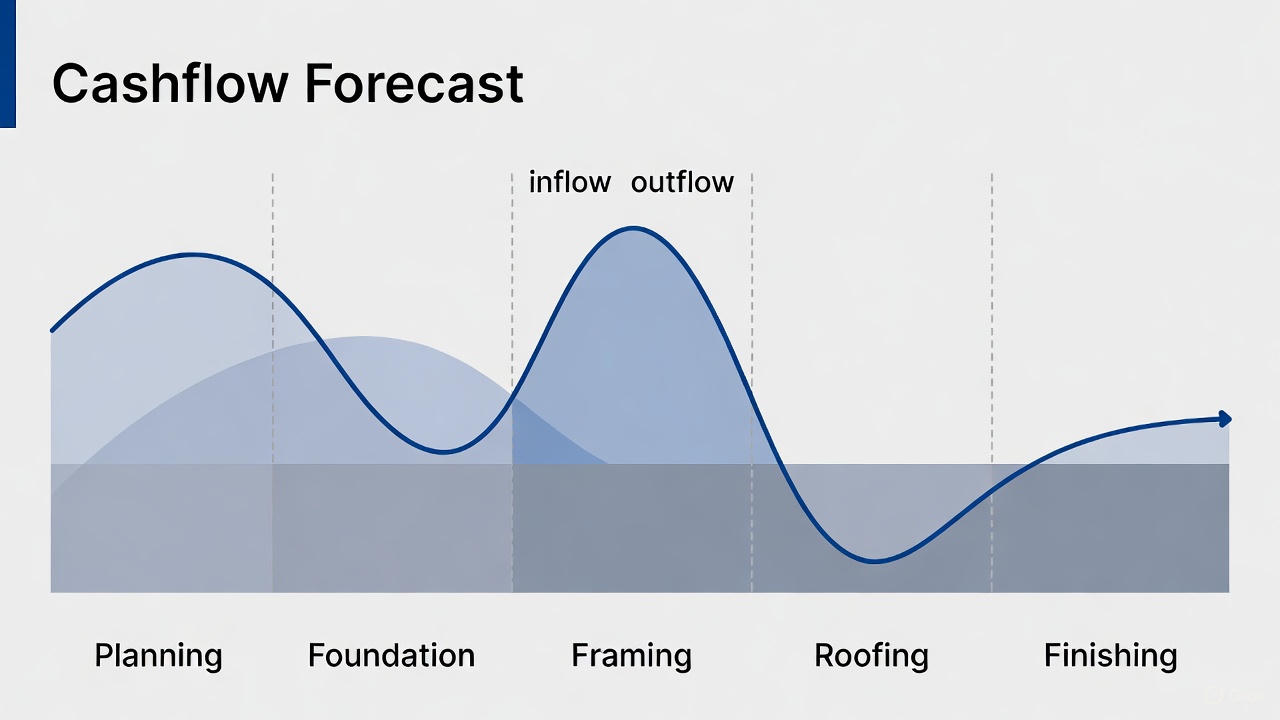
Construction cashflow forecasting is one of those tasks everyone knows is important — and almost no one truly trusts.
Despite decades of experience, most construction cashflow forecasts still rely on simplified Excel sheets, linear assumptions, and guesswork that barely survives first contact with reality. The result is predictable: forecasts that look acceptable on paper but fail to reflect how money actually moves through a project.
After seeing this problem repeatedly across tenders, bank financing exercises, and live projects, it became clear that the issue is not effort — it’s the model itself.
This article explains why most construction cashflow forecasts fail, and outlines a more realistic way to approach them.
Where Construction Cashflow Forecasts Go Wrong
1. They Assume Detail Exists When It Doesn’t
At tender stage or early project phases, engineers are often asked to produce a full cashflow while:
The detailed WBS does not exist
BOQs are incomplete or provisional
Construction methods are still evolving
Yet the forecast is expected to look “final”.
This forces estimators to invent monthly percentages or reuse old templates — not because it’s correct, but because something must be submitted.
2. They Treat Cashflow as Linear
Many forecasts quietly assume:
“If an activity lasts 10 months, then 10% of its value is spent every month.”
Construction does not behave this way.
Excavation is front-loaded
Concrete ramps up and down
Finishes peak late
MEP activities follow different curves entirely
Linear cashflows are convenient, but they are structurally wrong.
3. They Ignore Commercial Reality
A technically correct forecast can still be financially wrong if it ignores:
Advance payments
Retention and retention release
Defects Liability Period (DLP)
Time for payment
Work in excess of billing (WIEB)
Periods with work but no billing — or billing but no work
These are not edge cases. They define real cash movement.
4. They Confuse Precision with Accuracy
Highly detailed cashflows often look impressive — but they:
Take significant time and manpower to maintain
Break down as soon as scope or sequence changes
Are quietly abandoned during execution
In practice, a stable, high-level model often performs better than a fragile, ultra-detailed one.
A More Realistic Way to Model Construction Cashflow
A better cashflow forecast does not start with spreadsheets — it starts with what is realistically known early.
1. Start at Project Level
At early stages, the following parameters are usually available or can be reasonably estimated:
Project value
Advance payment terms
Retention and release rules
DLP
Expected WIEB
Time for payment
Capturing this logic upfront already eliminates many structural errors.
2. Use Activity-Level Abstraction (Not BOQs)
Instead of modeling:
Individual materials
Pipe diameters
Reinforcement quantities
It is often more effective to work with title activities, such as:
Excavation
Concrete works
Electrical
Mechanical
Finishes
Doors and windows
Each activity is defined by:
Start period
Duration (in periods)
Value
Optional subcontracting logic (advance, retention, payment delay)
Optional distortions (no work periods, no billing periods)
In practice, this results in:
~20 activities for small projects
~120 activities for large ones
Which is sufficient for banking, feasibility, and high-level control.
3. Model Distribution, Not Percentages
Instead of forcing linear spreads, activity values can be distributed using:
Normal distributions
Skewed curves based on activity type
User overrides where linear behavior is appropriate
This reflects how construction actually progresses — without requiring unrealistic detail.
4. Accept Uncertainty — Don’t Hide It
Early cashflows are estimates, not commitments.
A model that:
Acknowledges uncertainty
Uses reasonable assumptions
Produces consistent results
Is more valuable than one that pretends to be exact.
An Unexpected Outcome: Using High-Level Cashflows During Execution
Although this approach was designed primarily for early forecasting (tendering, bank financing, feasibility), it has also been used successfully as a final project cashflow reference during execution.
Not because it is extremely detailed — but because it is:
Stable
Understandable
Easier to maintain
On many projects, maintaining a very granular budget requires resources that simply aren’t available. A well-structured, high-level cashflow often ends up being the one management actually follows.
To be clear: this type of model generates cashflows only.
It does not handle execution follow-up, payments, or accounting — those belong in other systems. But as a reference framework, it can remain useful throughout the project lifecycle.
From Model to Tool
After seeing these issues repeatedly, I eventually implemented this logic in a small system to generate construction cashflows quickly — even when detailed breakdowns are not available.
That tool, CashflowPot by Quollnet, is essentially an attempt to encode these rules into software instead of relying on static spreadsheets.
The key lesson, however, is not the tool itself — it’s the modeling approach.
Final Thought
Most construction cashflow forecasts fail not because engineers lack skill, but because the models they are asked to use are misaligned with reality.
A good cashflow forecast:
Respects uncertainty
Matches the level of available information
Models how construction and payments actually behave
Less detail, when structured correctly, often leads to better decisions.